


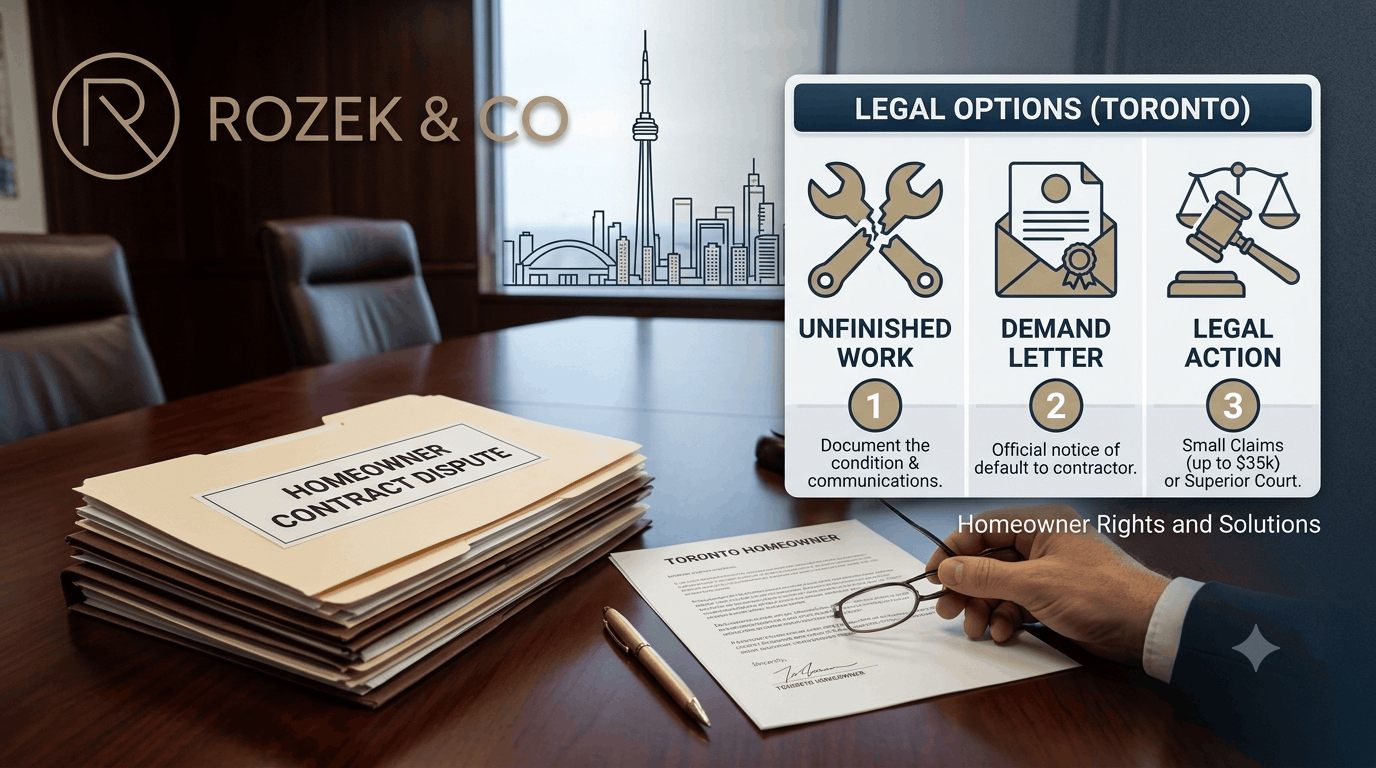

Few things are more stressful than a renovation that stops halfway. The kitchen is gutted, the deposit is gone, and your contractor has stopped returning calls. If that sounds familiar, you’re not alone. Contractor disputes are among the most common legal problems Toronto homeowners face, and the way you respond in the first few weeks can make a big difference to how it ends.
Start with the contract and the paper trail
Before you do anything else, find your contract and read it carefully. What was the scope of work? Was there a completion date? What does it say about payments, changes and ending the agreement? Even a short quote or an email exchange can count as a contract.
Then gather everything else: invoices, receipts, texts, emails and dated photos of the work. Take new photos now showing exactly where the project stands. If this ends up in front of an adjudicator or a judge, clear records are often what wins the day.
Put your concerns in writing
It’s tempting to fire off an angry text, but a calm, written notice works much better. Explain what hasn’t been done, refer to the contract, and give the contractor a reasonable deadline to return and finish. This gives them a fair chance to fix things, and it shows that you acted reasonably if the dispute goes further.
Be careful about withholding payment
Many homeowners simply stop paying, and that can backfire. Ontario’s Construction Act applies to many home renovation projects, not just big commercial builds. Since January 1, 2026, an invoice can be treated as a “proper invoice” unless you object in writing within 7 days, and if you don’t intend to pay some or all of it, you generally need to give a notice of non-payment within 14 days. You’re also generally expected to hold back 10% of each payment as a holdback.
If you get these steps wrong, the contractor may be entitled to payment even though the work is incomplete. They may also register a lien against your home, which can complicate refinancing or a sale. Our article on common construction disputes in Toronto explains how these situations usually unfold.
Your options for resolving it
Many disputes settle once both sides see the facts on paper. A lawyer’s letter often gets a contractor back to the table. If that fails, you have several routes. Construction adjudication is a fast, binding interim process for payment disputes under the Construction Act. Claims up to $50,000 can go to Small Claims Court, and larger ones go to the Superior Court of Justice.
If you hire another contractor to finish the work, keep detailed records of the extra cost. In many cases you can claim the difference from the original contractor, as long as you acted reasonably to keep costs down.
When to call a construction lawyer
If a lien has been registered, the amounts are significant, or you’re unsure whether to pay the next invoice, it’s worth getting advice quickly. Deadlines under the Construction Act are short, and missing one can cost you leverage.
Our guide on how to find a construction lawyer for a residential dispute in Toronto explains what to look for. When you’re ready, our Toronto construction lawyers can review your contract and help you choose the fastest path to getting your home finished.
Talk to a construction lawyer at Rozek & Co.
This article is general information, not legal advice.
